

Agents that act as you.
But aren’t you.
Say the outcome. A crew of specialists plans it, runs it in isolated sandboxes, and proves it before calling it done.
- A sandbox per run — your machine is untouched
- Checks before it says done, gaps included
- Your code is not training data
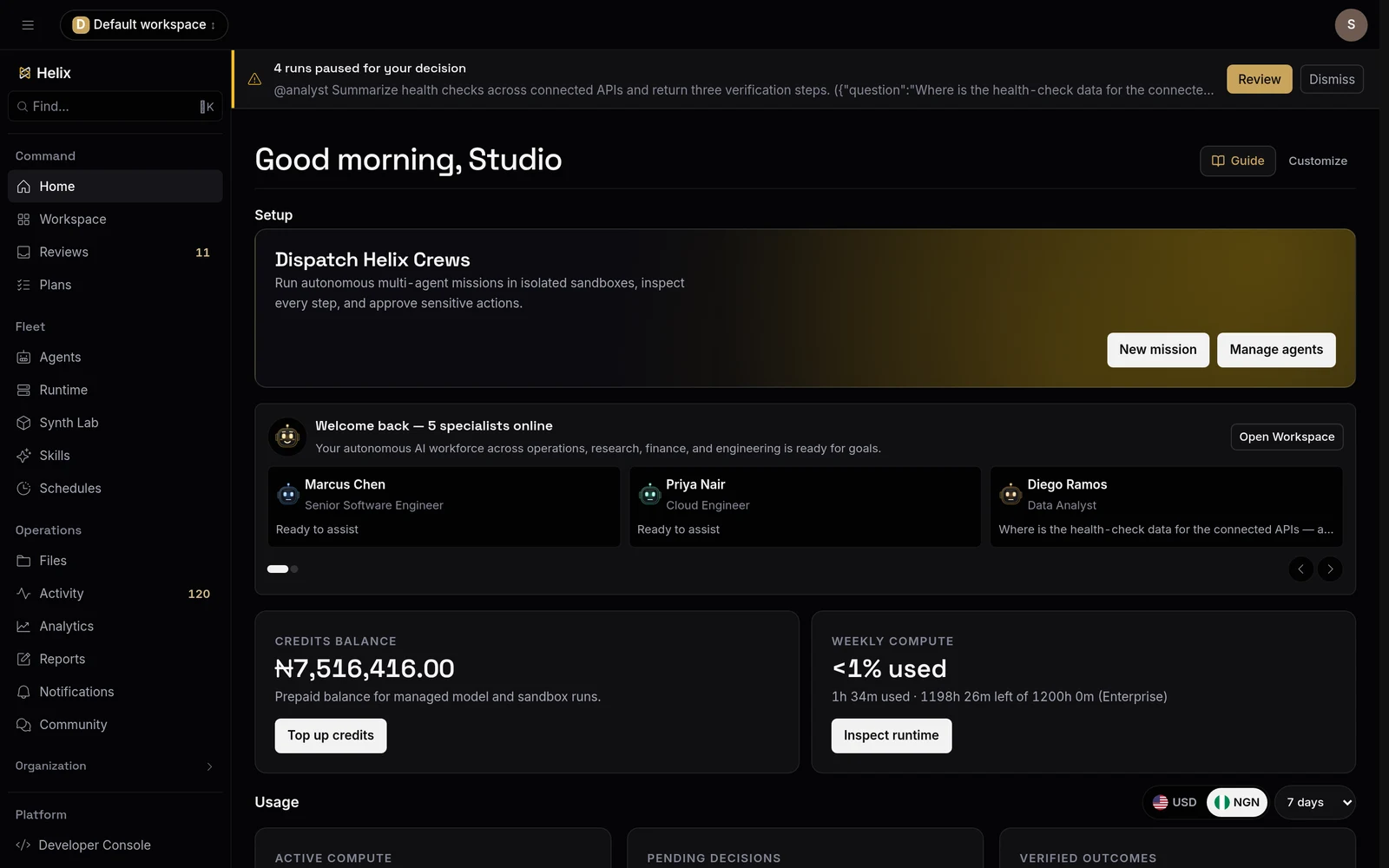
Say it. Watch it. Cap it.
Say the outcome
Plain words. Helix writes the plan and routes each task to the specialist whose tools fit it.
Watch the work
Each conversation gets its own machine. Every command, file and reason is visible as it happens.
Cap the autonomy
One setting. Below it your crew works unattended; above it, an action waits for you.
Five specialists, ready on day one
Real tool grants. Not personas.
Builds and fixes. Never ships without the checks.
Environments and previews. Verifies a service before calling it up.
Every figure derived, every result exported as a file.
Cites every claim. Says so when sources disagree.
Drafts and organises. Asks before anything leaves the building.
Describe the specialist you need. Helix builds it — its tools, its scope, its budget.
Everything a run needs, already wired
A machine, a tool surface, and a record.
Its own machine
A Linux machine per run. Your laptop is not the workbench.
A real shell
Install, build, test, serve — nothing blocks the run.
The workspace survives
Parks between messages, keeps its disk. Tomorrow picks up where today stopped.
Deliverables outlive the sandbox
Written to durable storage before teardown. The report outlives the machine.
The whole product, not a mock
Screens from the running app, both themes.
What a finished task looks like
The deliverable, the checks, and what could not be verified.
It shows its work, not just its answer
Every step on the record — the plan, each command and what came back, and which specialist ran it. Reopen the thread next week and it is all still there.
goal Add a rate limit to the public API and prove it works. plan Marcus Chen read the router, add the limiter Diego Ramos confirm the limits hold under load crew_note Marcus Chen (Senior Software Engineer): On it — reading the router first to see where the middleware chain starts. tool_call read_file src/api/router.ts result ok 214 lines tool_call edit_file src/api/router.ts result ok +18 −2, read back and compared tool_call run_command npm test result exit 0 14 passing crew_note Diego Ramos (Data Analyst): Load-tested 200 concurrent requests — the 21st gets 429 with Retry-After. answer Added a token-bucket limiter to the public router and covered the 429 path. npm test passes (14). verified npm test exited 0 after the last write evidence tool_result run_command → exit 0 gap not load-tested past 200 concurrent requests46 integrations, connected in a minute
An API key or a webhook URL. No approval queue.
 GitHub
 Linear
 Jira
 Sentry
 Vercel
 Netlify
 Railway
 Render
 Fly.io
 Cloudflare
 DigitalOcean
 Hetzner
 Supabase
 Neon
 PlanetScale
 MongoDB Atlas
 Slack
 Discord
 Telegram
 WhatsApp (Twilio)
 Matrix
 Notion
 ConfluenceGitHubLinearJiraSentryVercelNetlifyRailwayRenderFly.ioCloudflareDigitalOceanHetznerSupabaseNeonPlanetScaleMongoDB AtlasSlackDiscordTelegramWhatsApp (Twilio)MatrixNotionConfluence
 Dropbox
 Figma
 Coda
 Airtable
 PostHog
 MixpanelAmplitude
 Stripe
 PlausibleMicrosoft Clarity
 Typeform
 Canva
 Dribbble
 Unsplash
 Mailchimp
 BrevoKlaviyo
 Zendesk
 Help ScoutAmazon S3
 CloudinaryWeb search & fetchFile uploadDropboxFigmaCodaAirtablePostHogMixpanelAmplitudeStripePlausibleMicrosoft ClarityTypeformCanvaDribbbleUnsplashMailchimpBrevoKlaviyoZendeskHelp ScoutAmazon S3CloudinaryWeb search & fetchFile upload
Pricing
Read from the same plan registry the product uses.
| Plan | Price |
|---|---|
| Free | ₦0 |
| Pro | ₦10,000 /mo |
| Team | ₦40,000 /mo |
| Enterprise | ₦100,000 /mo |
Yearly saves 20%. Billed in naira.
Before you start
Do I need to know how to code?
No. You describe an outcome in a sentence. The plan, the tools and the checks are the platform's job — the transcript is written so a non-engineer can follow what happened.
How is this different from a coding assistant?
An assistant helps you do the work. Helix does the work and then shows you it was done: a plan you can read, a machine it ran on, and evidence from the checks themselves rather than a summary it wrote about itself.
What stops it doing something I did not want?
Autonomy is a level you set, and a destructive action asks regardless of that level. You can stop any run, and stopping keeps the transcript and the workspace.
Is my code used for training?
No. Workspace contents, transcripts and artifacts are not training data — ours or anyone else's.
What happens when I run out of usage?
The run pauses and the message names when the window resets. Nothing already done is lost, and the next message continues from the checkpoint.